THE RAMBLINGS OF A FRENCH CANADIAN WARGAMER

Wednesday, March 13, 2013

Basing tutorial; basing my Canaanites

My Biblical project came with a new challenge; desert terrain. As such, I had to base my army accordingly. Now my regular basing technique  involves using Wood putty to texture the base, sand as grass and adding the occasional rocks and bushes. Usually I go with a brownish autumn as my main base colour. I really like the looks of putty for basing purpose a lot and as such the flock/sand method is dead to me!

I spent some time looking at pictures of terrain of the Levant (Israel, Liban) to figure that I was aiming at more of a "rocky desert" type of terrain than a "sandy desert".


Once I had an idea of what I wanted to achieve, I went to my local artstore and bought a bunch of colours, and made some tests. For basing, I use cheap Acrylic paint tubes, in my case Amsterdam All Acrylics. I'm quite loyal to a brand once I find something I like, and I've been using these for years. I'll spare you the details but after a couple of tests I found what I was looking for. 

I've had a few inquiries on my method in recent weeks, so here is how I do it. Pretty simple, really.

You will need :
  • Cheap acrylic paints
  • Wood putty
  • A couple of small differently sized artist spatulas
  • Some medium artist brushes
  • A large drybrush
  • Tufts of different seasons, I get the Stilflor ones from Scenic Express
  • Fish tank aggregates


First step is to cover the bases with wood putty. If the putty is a little dry, moisten with water and it should make it more malleable; the stuff dries fast though so once you start a base don't waste time and don't take a tea break! Cover the figure's base as much as possible. You don't want a smooth surface here, so don't hesitate to create cracks and such on the base. Leave it to dry for at least a couple of hours until it's rock solid. Then you can put a few rocks (fish tank aggregates) here and there; I use superglue but white glue will work just fine.

It's now time to start the painting. Paint the bases Burnt Sienna. A good first coat is important to avoid chipping in the future so I usually use two coats just to be sure.


Then apply a wet coat of Raw Sienna. If you still see faint traces of the base coat it's ok, it will look more natural that way.


Drybrush the whole base with Naples Yellow Deep. You want a much lighter colour to really bring out the details. For a better finish you can use successful highlights of lighter colour but I only do this on individual pieces as it really is more time consuming.

The magic of drybrushing!


Now just add a couple of tufts here and there et voilà! The job is finished. Give the base a good coat of matt varnish for extra protection and pour yourself a congratulatory drink; one more unit finished!


Tuesday, March 12, 2013

Shasu Bedouins

Today au menu we have a unit of Shasu Bedouin javelineers for my Canaanite army. The Shasu Bedouin were Semitic speaking pastoral cattle nomads who appeared in the Levant from the late Bronze Age to the Early Iron Age. They were organized in clans under a tribal chieftain. Regarded as outcasts and brigands, they were usually hired as mercenaries to supplement the forces of the Canaanite kings.

I stayed true to my army colour scheme but included more raw linen clothes to reflect the Shasu's standing or lack thereof. Although I did went colourful on the headgears.


As usual, the figures are Foundry, bases by Litko. 


These guys are my 5th submission of the contest and give me 60 pts. I'm still way behind my objective but I intend to do my best to at least send one more submission before the end of the contest.

Tomorrow, a tutorial on my basing method, using these guys as examples.

Thursday, March 7, 2013

Raid au Massachusetts!

A few weeks back we played our first game of FIW using my new collection. It was also my first time to show off many of the terrain I've been collecting for years in anticipation of my FIW project. Although please excuse the lack of historical accuracies of some of the buildings, I still have to get more specific FIW cabins and farms.

John faced Nicolas while I got to be GM. Funnily, the game pitted John, now living in Massachusetts and playing the Colonial Militia/British against Nicolas, a French now living in Québec. Can't beat that realism!

We played two games, both with the excellent ruleset This very Ground. It went really well I think and we had a blast. I was always more of a big battle type of wargamer but I must say FIW Skirmish is a lot of fun. I designed two scenarios that were linked together; the first was a raid on a settlement by a mixed Canadian and Indian war party and the second was the pursuit in the woods between the retreating party and British forces.
Unfortunately I have few pics from the first game, as the sun was in full force and ruined most of them, as you can see from the first pic. And the second game was over too quickly to take many pics. But still, there's a couple of decent shot. I was quite happy with the look of the games.

The first game set-up : John's militia had to protect the three farms
Shots exchanged between Militia and Indians
Charge!
The 2nd game : Nicola's party had to exit the table at the top
The two sworn enemies thinking about their strategy
Redcoats trying to intercept the F&I

The first game was very tight and for a while it looked as if the the outnumbered Militia might succeed in defending their farms, but a late push by charging indians changed the outcome in a hurry.

The second game was not as close, in part because of horrendous bad luck from Nicolas and in part because there was a thing or two that could've been more balanced with the scenario. John certainly didn't help Nicolas with his great gameplan! Bad John, bad!

I rarely say this but those This very ground rules are so good I don't feel the need to try other rules from the period. The shooting mechanism, especially, is pure genius. I'll have to work on some Rangers and Compagnies Franches, as this is the first but certainly not the last of our FIW games.

Sunday, March 3, 2013

First Chariots (finally!)

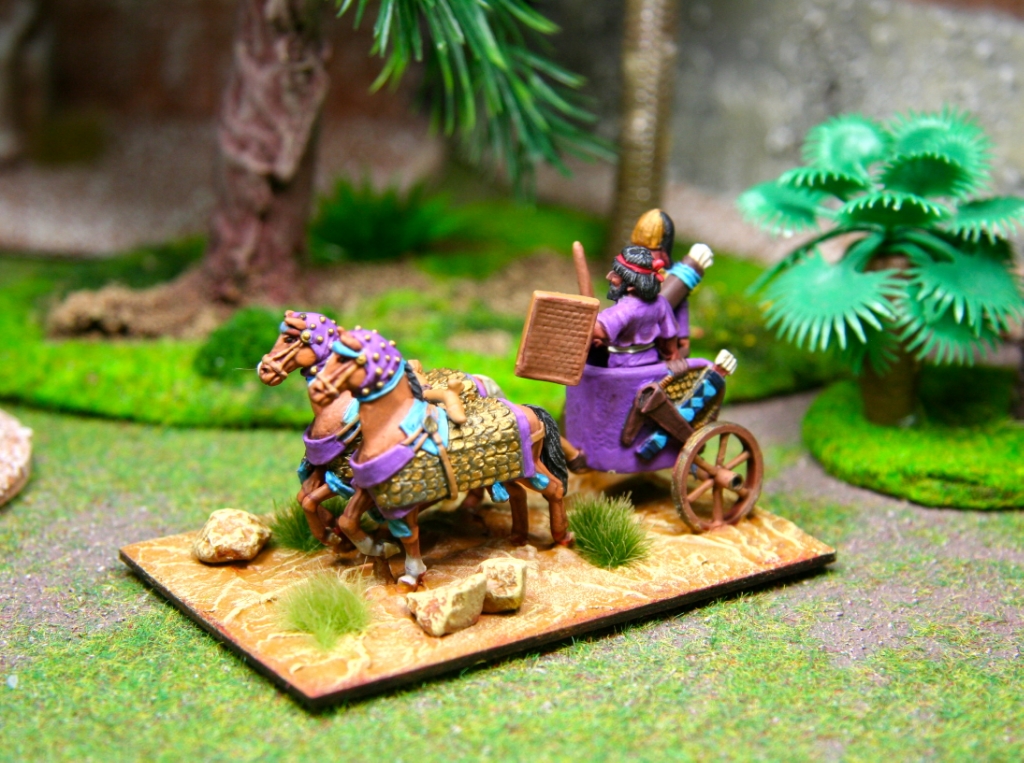
Well it took longer than expected but I finished my first batch of chariots. I know I said they would be done last monday, and in fact they were! It's just that they are a submission for the Analogue contest and as per the rules I had to wait for Curt to show them first on his blog before I could do the same. Unfortunately Curt was super busy this week so while I sent the pics last monday he put them up on his blog yesterday.

The primary striking arm of the Canaanite armies,  the elite chariot corps was manned by the social elite of feudal nobles called Maryanna (chariot warriors). Each Maryannu was a professionnal warrior who maintained his chariot, horses, grooms, driver and equipment at his own expense. The Maryannu's wealth was derived from his holding of a fief granted by his king. The Canaanite chariot was heavily influenced by its Mitannian counterpart, and was heavier than the Egyptian vehicle but lighter than the Hittite machine. 

The Canaanite chariot warrior was heavily protected by a mail coat of scale armour. His horse, too, wore a bronze scale coat. This armour consisted of a mail coat with sleeves and a long skirt covered with individual bronze scale plates. The scaled coat and skirt required almost a thousand scales to fabricate, with the sleeves another 200 scales! These devices were designed to protect the horse and crew from the enemies' arrows as they closed to engage. The most common helmet of the era was the bronze helmet. The charioteer neck was often protected by a high, thick bronze collar, typical of the armours of the period. In contrast with the Egyptians and Hittites, the chariot driver was often also well equipped with scale armour and helmet. The driver also carried a small shield (aritu) made of beaten bronze covered wood.

The primary weapons of the Maryannu were the composite bow (plus two quivers of arrows attached to the chariot), a heavy spear and a club, the latter to be used only in the direst emergency should the warrior find himself afoot. These weapons suggest that the tactical role of the chariot was not to fight in close quarters as the Hittites, but rather to either fire or as passing engagement. Both the bow and lance were to be either used from afar or en passant if closely engaged. These chariots could be equally efficient against the heavy chariots of the Hittites or the lighter Egyptian chariots. When fighting Egyptian chariots, the Canaanite machine gave it's charioteer an equal capability of firepower since both the Egyptians and Canaanites were armed with the same composite bow. While the Egyptian chariot held advantage in both speed and maneuverability, the Canaan plains did not offer many opportunities for battle on flat, even plains. The heavier Canaanite vehicle, with it's far better protected charioteer, offered greater advantages in delivering shock and increasing the archer's survivability both when engaged at close range en passant and when employed on uneven terrain, which itself could neutralize the Egyptians' advantage in speed and mobility.

Chariot horses were prized and expensive military assets, and there was an organized system for acquiring, breeding and training horses. Horses began training with the chariots when they were a year old and began pulling chariots by their 3rd year. By their 4th year they became proper chariot horses until their retirement at age 9 or 10.

(source : Richard A. Gabriel, Thutmose III)

Other than one Warhammer Chaos chariot painted well over a decade ago, this was my first time painting chariots. As such I decided to settle on a manageable 3 chariots at a time. After painting 3 chariots, I'm pretty sure this will be my magic number from now on. Chariots do take a lot of time to paint, what with the chariot body, wheels, 2 horses and 2 crews. 

I wanted a colour scheme to set the chariots apart from the rest of the army, which is mostly in red and pale blue, to convey their elite status. I chose purple because the region was known for its purple dye, which was laboriously produced from murex shells. The purple cloth was well known far and wide and later was associated by the Romans with nobility and royalty. Fitting, I thought. Having said that I will probably vary the colour scheme between Chariot units. These 3 chariots will be part of a bigger chariot unit, probably made-up of 6 vehicles.
Although I'm still wondering if I should go instead with smaller 4 chariots units. Food for thought.

I had a few problems along the way, most notably my Army painter drying unexpectedly just when I was about to AP the finished models. Not a big problem just an annoying one. Also yours truly in a stupid clumsy move dropped a wheel on the garage floor when varnishing the models, doh! The wheel ended up below the car, in the winter slush! Panicked, I removed the car and started looking for the wheel, which I found in good shape in the middle of small rocks and salt after a few minutes of  cursing. That was close, as I bloody hate painting wheels! 

I also expect the assembly will go smoother next time. Just little things you learn as you go.

So here are the first 3 chariots of my Canaanite army; the chariots are Cutting Edge and the crew are a mix of Cutting Edge and Foundry. I'll post a review and comparisons of Foundry and Cutting Edge chariots this week to explain why you'd be certifiably insane to pick Foundry chariots over Cutting Edge's. In the end I went with 50x80mm bases, the 50x100mm didn't look right.


So these are my 4th submission of the contest and give me 105 pts.
On the workbench : Bedouin skirmishers and more Canaan Militia Spearmen.